Spec-Driven Development brings structure to AI coding by defining intent before execution. Learn how SDD replaces trial-and-error with clarity, control, and higher-quality software through a disciplined, production-ready workflow.
How spec-driven development is redefining AI coding workflows
Artificial intelligence has changed how software is written. What once required weeks of structured effort can now be prototyped in minutes. A prompt, a suggestion, a few iterations, and suddenly there is code on the screen that appears to work.
This new dynamic has given rise to what many teams casually call Vibe Coding: an improvisational, conversational way of building software with AI. It feels fast. It feels creative. And for early experimentation, it often feels productive.
But as organizations move from demos to production, from experiments to core systems, that initial excitement frequently collides with reality: brittle implementations, unclear intent, mounting technical debt, unpredictable behavior, and rising costs.
The question for modern engineering teams is no longer whether to use AI in software development. The real question is how to use it with discipline.
This is where Spec-Driven Development (SDD) enters the conversation, and where companies like Ceiba Software have taken the concept further through the creation of the Ceiba Method: a development methodology designed to amplify human expertise through the correct, governed, and intentional use of AI.
Vibe Coding vs spec coding
Vibe Coding resembles a jazz session. A developer interacts with an AI assistant in real time, riffing on ideas, adjusting code on the fly, and letting intuition guide the process. For prototypes, proofs of concept, and early exploration, this approach can be powerful.
However, jazz depends heavily on individual skill, context, and improvisational judgment. When scaled across teams, products, and long-lived systems, improvisation becomes risk.
Spec Coding, by contrast, is orchestral.
In an orchestra, every musician knows exactly what to play, when to play it, and how it fits into the whole. The conductor defines tempo, structure, and interpretation. Creativity still exists, but within clear boundaries that ensure consistency, harmony, and repeatability.
Spec-Driven Development applies this orchestral mindset to AI-assisted coding. Instead of letting the AI “guess” what to build, humans define intent explicitly through specifications that guide the AI’s output.
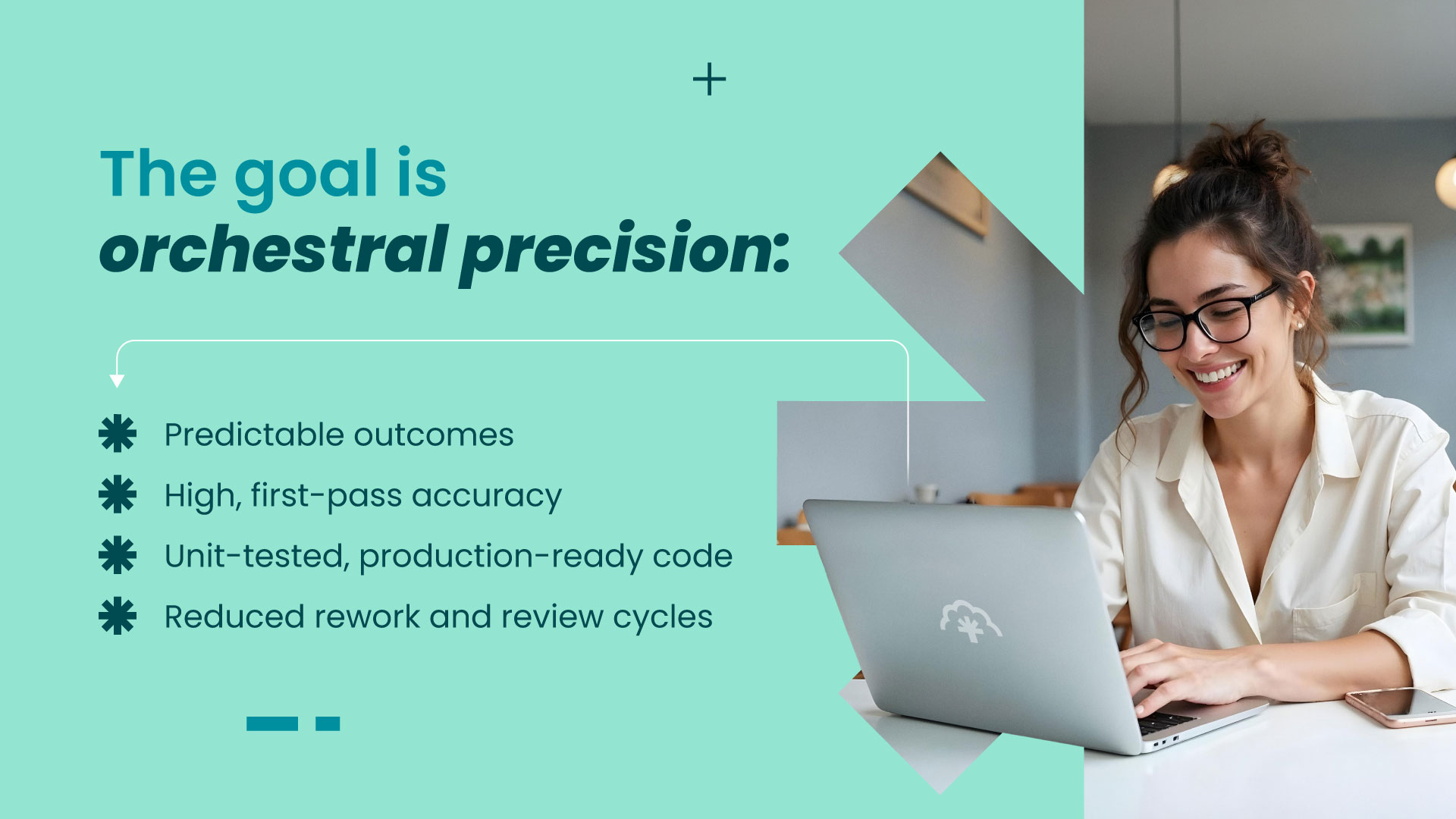
In mature SDD implementations, teams aim for 95% or higher accuracy on the first attempt, not because the AI is smarter, but because the instructions are.
What is a specification in spec-driven development?
A common misconception is that a “spec” is just a longer prompt. It is not.
In Spec-Driven Development, a specification is a structured, behavior-oriented artifact written in natural language that expresses what the system must do and the guardrails under which it must operate.
A good spec answers three critical questions:
- What problem are we solving?
Defined through user stories, outcomes, and acceptance criteria. - What constraints must be respected?
Architecture principles, security rules, compliance requirements, performance targets, and coding standards. - How will success be validated?
Testability, edge cases, and measurable behaviors.
Crucially, the spec becomes the single source of truth for both humans and AI. It is distinct from general documentation or “memory banks.” While architectural principles and organizational standards may live elsewhere, the spec is the executable intent of a specific feature or system.
At Ceiba Software, this concept is embedded deeply into the Ceiba Method, where specifications are not bureaucratic artifacts, but knowledge amplifiers that transfer business understanding into AI-augmented execution.
You might also be interested in: Building Scalable Data Foundations to Drive Business Value
The Spec-Driven development workflow
Spec-Driven Development introduces explicit checkpoints designed to give humans control over AI-assisted workflows without slowing teams down.
Phase 1: Specify defining the “What”
The first phase focuses entirely on intent.
Business requirements are captured in natural language using user stories and acceptance criteria. Technical implementation details are deliberately excluded at this stage.
This separation is critical. When requirements and implementation are mixed too early, ambiguity increases and AI outputs become inconsistent.
Phase 2: plan defining the “How”
In this phase, the AI agent is instructed to think before coding.
Based on the approved specification, the agent produces a detailed plan that includes:
– Architecture considerations
– Dependencies and constraints
– Security and compliance rules
– Performance expectations
This planning artifact acts as a contract between human intent and machine execution.
Within the Ceiba Method, this phase is reinforced by domain expertise from Ceiba’s development teams, ensuring that AI-generated plans align with real-world enterprise constraints, not just theoretical best practices.
Phase 3: tasks breaking work into actionable units
The plan is then decomposed into a sequence of small, bounded tasks. Each task is designed to be implemented and tested in isolation.
This approach dramatically reduces error propagation. Instead of debugging a large, opaque codebase, teams review incremental, verifiable progress.
Phase 4: implement and execute
Only now does code generation begin.
Tasks are executed in small subsets, with continuous validation through compilation and unit testing. Human review remains central, not as a safety net, but as a quality amplifier.
Learning and refinement
Corrected errors and insights are logged in a Lessons Learned artifact. Over time, this creates a feedback loop that improves both human specifications and AI behavior.
This continuous learning layer is a cornerstone of the Ceiba Method, ensuring that AI adoption increases team knowledge instead of eroding it.
Levels of spec-driven development adoption
Not all teams adopt SDD at the same depth. In practice, three maturity levels emerge.
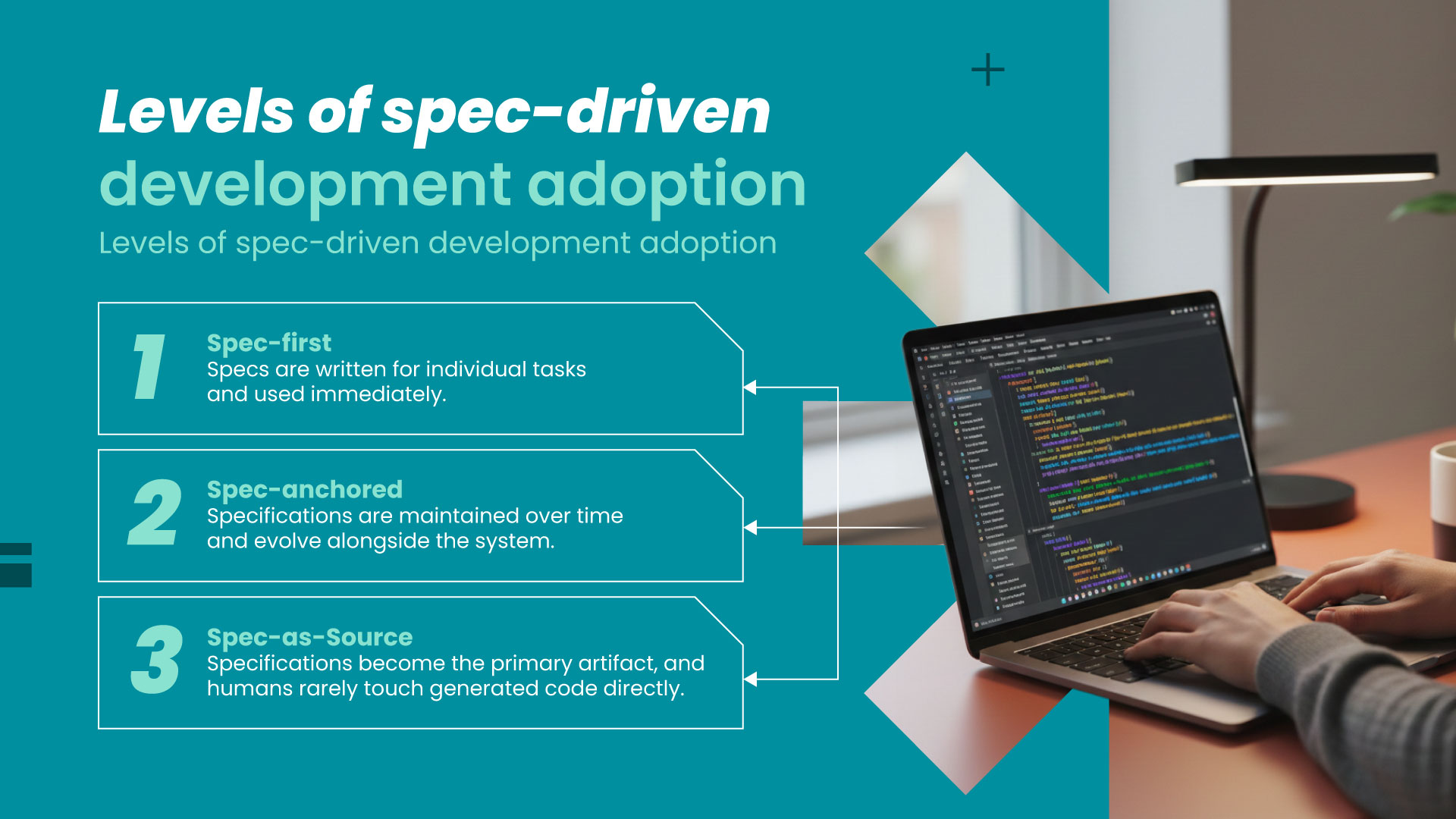
While promising, this level carries risks reminiscent of past Model-Driven Development approaches, especially when combined with the non-deterministic nature of large language models.
Ceiba Software deliberately takes a pragmatic stance here. The Ceiba Method leverages specs as authoritative guidance while keeping human engineering judgment firmly in control.
You might also be interested in: Top AI Agents for Devs: Tools to Boost Productivity in Software Development
Why spec-driven development matters for AI ROI
One of the least discussed consequences of uncontrolled AI coding is cost.
AI that generates incorrect or low-quality code does not save money. It shifts cost downstream into debugging, rework, cloud inefficiencies, and operational instability.
From a FinOps for AI perspective, Spec-Driven Development delivers measurable benefits:
– Fewer AI tokens wasted on trial-and-error prompting
– Reduced engineering hours spent fixing generated code
– Lower cloud costs due to more efficient, intentional architectures
– Predictable delivery timelines
By turning intent into structured input, organizations extract more value per AI interaction.
At Ceiba, the Ceiba Method was designed precisely to address this challenge: enabling teams to scale AI usage responsibly while maintaining financial and architectural control.
Orchestral precision as a competitive advantage
In enterprise environments, speed alone is not a differentiator. Precision is.
Orchestral precision means:
– Clear ownership of intent
– Repeatable delivery outcomes
– AI as a force multiplier, not a wildcard
– Systems that are resilient, auditable, and evolvable
Spec-driven development shifts the source of truth from code to intention. When combined with a disciplined methodology like the Ceiba Method, AI becomes an extension of the engineering team’s expertise rather than a replacement for it.
Challenges and critical realities of SDD
Spec-driven development is not without friction.
– Review overload can occur if specs become verbose and poorly structured.
– Inflexible workflows may feel excessive for small changes.
– False confidence can emerge when teams assume specs eliminate AI unpredictability.
– Ambiguity remains difficult to eliminate entirely, especially at the boundary between functional and technical requirements.
The key is not blind adoption, but thoughtful implementation.
Ceiba Software addresses these challenges by emphasizing engineering judgment, contextual decision-making, and continuous refinement within the Ceiba Method. AI is treated as a collaborator that must be guided, not an oracle to be trusted blindly.
Vibe Coding showed the world what was possible. Spec-driven development shows what is sustainable.
As AI becomes a permanent part of software engineering, organizations must evolve beyond improvisation. They need frameworks that preserve creativity while enforcing clarity, control, and accountability.
The Ceiba Method represents Ceiba Software’s answer to this evolution: a way to boost the knowledge of development teams, align AI with business intent, and deliver software with orchestral precision.
In the end, the future of AI-driven development will not belong to those who code the fastest, but to those who compose the best systems. Contact out team to know how to be one of them.
Let’s Talk
You might also be interested in:
- The Actual St
- ate of AI and How It’s Impacting Organizations
- What clients really want from AI consulting
- AI-Powered Coding: How Great Teams Balance Speed, Quality, & Risk